
Permanent Fund Dividend Reform
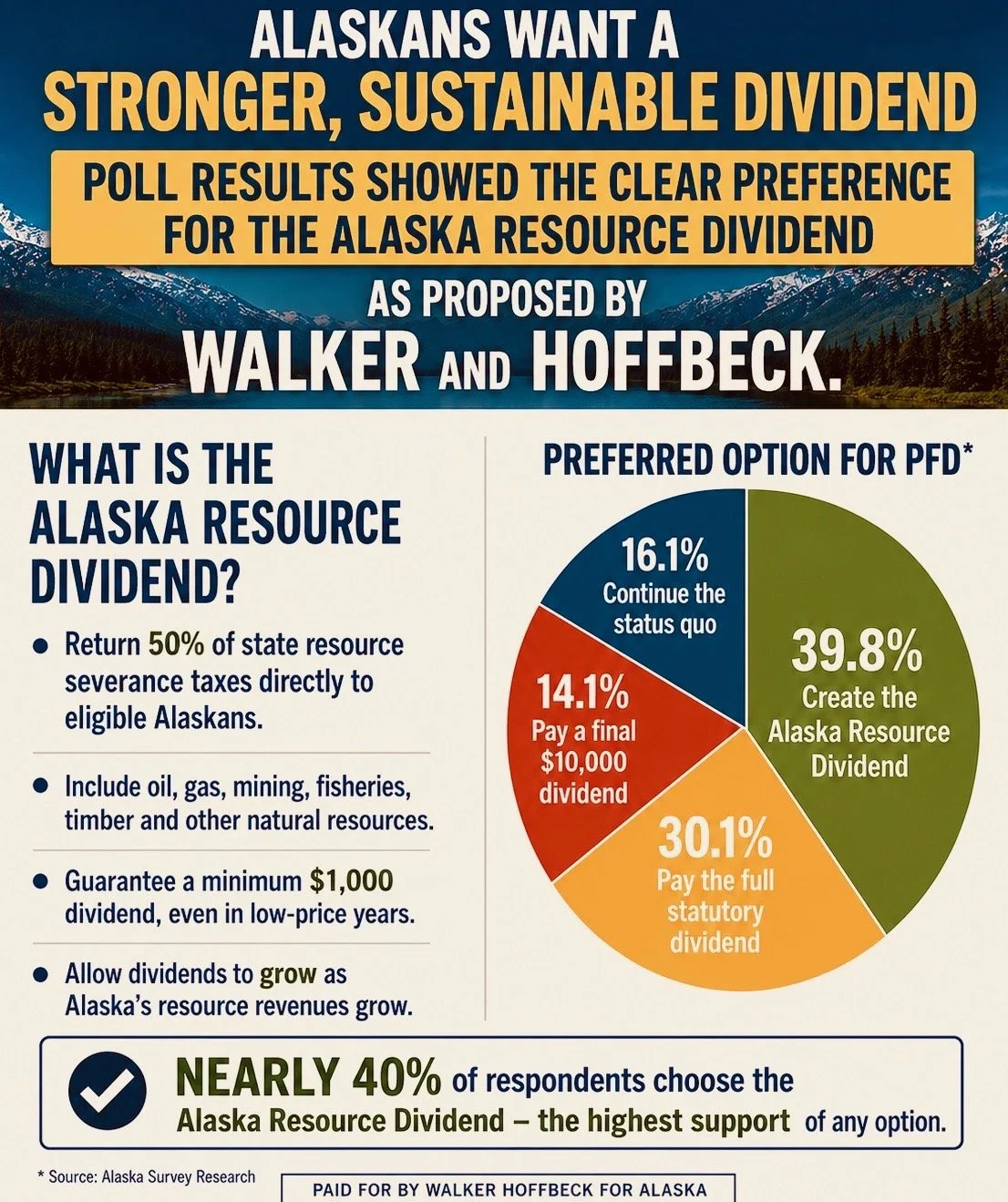
A True Resource Dividend for Alaska
Policy Statement
For nearly a decade, Alaska has been trapped in an annual political fight over the Permanent Fund Dividend. Every year the debate is the same. How much should the dividend be? How much should government receive? Which formula should be followed?
The result has been uncertainty for Alaska families, uncertainty for state budgeting, and growing frustration for everyone involved.
Walker–Hoffbeck believes Alaska can do better.
Our conversations with Alaskans produced two clear messages.
First, Alaskans are tired of the annual political battle over the dividend and want a system that is predictable, transparent, and not subject to yearly political negotiations.
Second, although today's dividend is no longer directly connected to current resource revenues, Alaskans still view it as their share of Alaska's publicly owned resource wealth.
Those conversations led us to a simple question:
Can Alaska preserve the dividend while ending the annual political fight over it?
We believe the answer is yes.
Returning the Permanent Fund to Its Intended Role
The Permanent Fund was created to convert a portion of Alaska's nonrenewable resource wealth into a permanent financial asset. As oil production declined, the earnings from that asset would help support essential public services while preserving wealth for future generations.
That mission has been an extraordinary success.
Today the Permanent Fund is one of the world's most successful sovereign wealth funds and provides a stable source of revenue for state government.
Walker–Hoffbeck believes it should continue serving that purpose.
A True Alaskan Resource Dividend
The dividend, however, should once again be directly connected to Alaska's natural resources.
Walker–Hoffbeck proposes creating a True Resource Dividend funded directly from the taxes generated by the development of Alaska's publicly owned natural resources.
Under this proposal:
The Permanent Fund remains unchanged. Constitutional royalty deposits continue as they do today, preserving the fund for future generations.
Fifty percent of all state production tax revenues generated from Alaska's natural resources would be deposited into a Dividend Fund.
The remaining fifty percent would continue supporting state government and essential public services.
All revenue deposited into the Dividend Fund during the previous fiscal year would be distributed equally among eligible Alaskans.
Every eligible Alaskan would receive a guaranteed minimum dividend of $1,000, protecting families during periods of low commodity prices or reduced production.
The formula is straightforward.
When resource development grows, dividends grow.
When production or commodity prices decline, dividends decline.
Every Alaskan can clearly see where the money comes from and why the dividend changes from year to year.
Aligning Alaska's Future
This proposal puts Alaska's citizens, Alaska's economy, and Alaska's fiscal policy on the same side.
Responsible resource development creates jobs, strengthens communities, generates revenue for government, and increases the dividend paid to Alaska families.
Everyone benefits.
Most importantly, the proposal restores a direct connection between Alaska's publicly owned resources and the people who collectively own them.
The Permanent Fund would continue protecting Alaska's long-term financial future.
The Dividend Fund would ensure that every Alaskan shares directly in the value created as our natural resources are responsibly developed.
One fund protects Alaska's future.
The other shares Alaska's resource wealth.