
Oil Tax Reform:
Getting Alaska the Fair Share We Were Promised
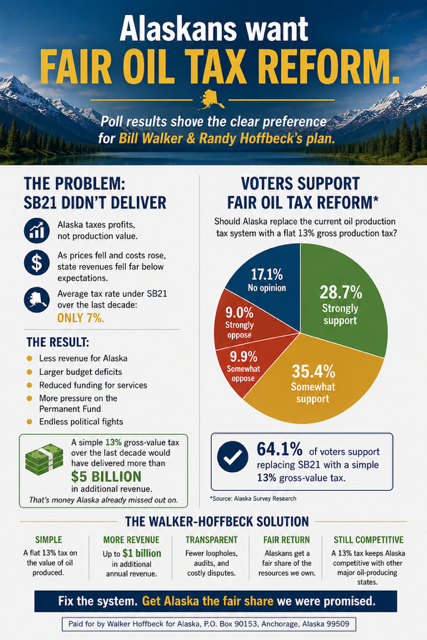
This proposal is not about raising taxes just to raise more revenues. It is about fixing a tax system that failed to deliver what Alaskans were promised. If SB21 had produced the revenues Alaskans were promised, we would not be having this discussion today.
When SB21 was passed, Alaskans were told lower oil taxes would lead to more production, more investment, and strong revenues for the state. Instead, Alaska spent much of the last decade facing budget deficits, reduced services, endless fights over the Permanent Fund Dividend, and growing fiscal uncertainty.
The issue is not that oil companies did anything wrong. Oil companies have a responsibility to maximize returns for their shareholders. The real question is whether Alaska created the right system for Alaskans. We do not believe it did.
WHAT WENT WRONG?
For more than a decade, Alaska has relied on an oil tax system that taxes profits rather than production value.
As oil prices fell and deductible expenses increased, the amount of money flowing to the state often fell far below expectations.
Over the last decade, Alaska collected an average effective gross-value tax rate of only 7% under SB21.
The result was predictable:
Less revenue for Alaska
Larger budget deficits
Reduced funding for essential services
Increased pressure on the Permanent Fund
Endless political fights over the PFD
Had Alaska used a simple 13% gross-value tax during the last decade, the state would have received more than $5 billion in additional revenues.
That is not a future projection. That is money Alaska already missed out on.
THE WALKER-HOFFBECK SOLUTION
Walker-Hoffbeck proposes replacing SB21 with a simple 13% tax on the value of oil produced.
Instead of relying on complicated profit calculations, deductions, credits, audits, and disputes, Alaska would receive a straightforward share of the value of the resource that belongs to the people of Alaska.
This approach would:
Make the tax system easier to understand
Increase transparency
Reduce costly disputes and audits
Create more predictable state revenues
Treat oil and natural gas under a similar framework
Most importantly, it would help ensure Alaska receives a fair return from the resources it owns. A return that, depending on price and volume, could yield up to $1 billion in additional annual revenue.
IS ALASKA STILL COMPETITIVE?
Yes.
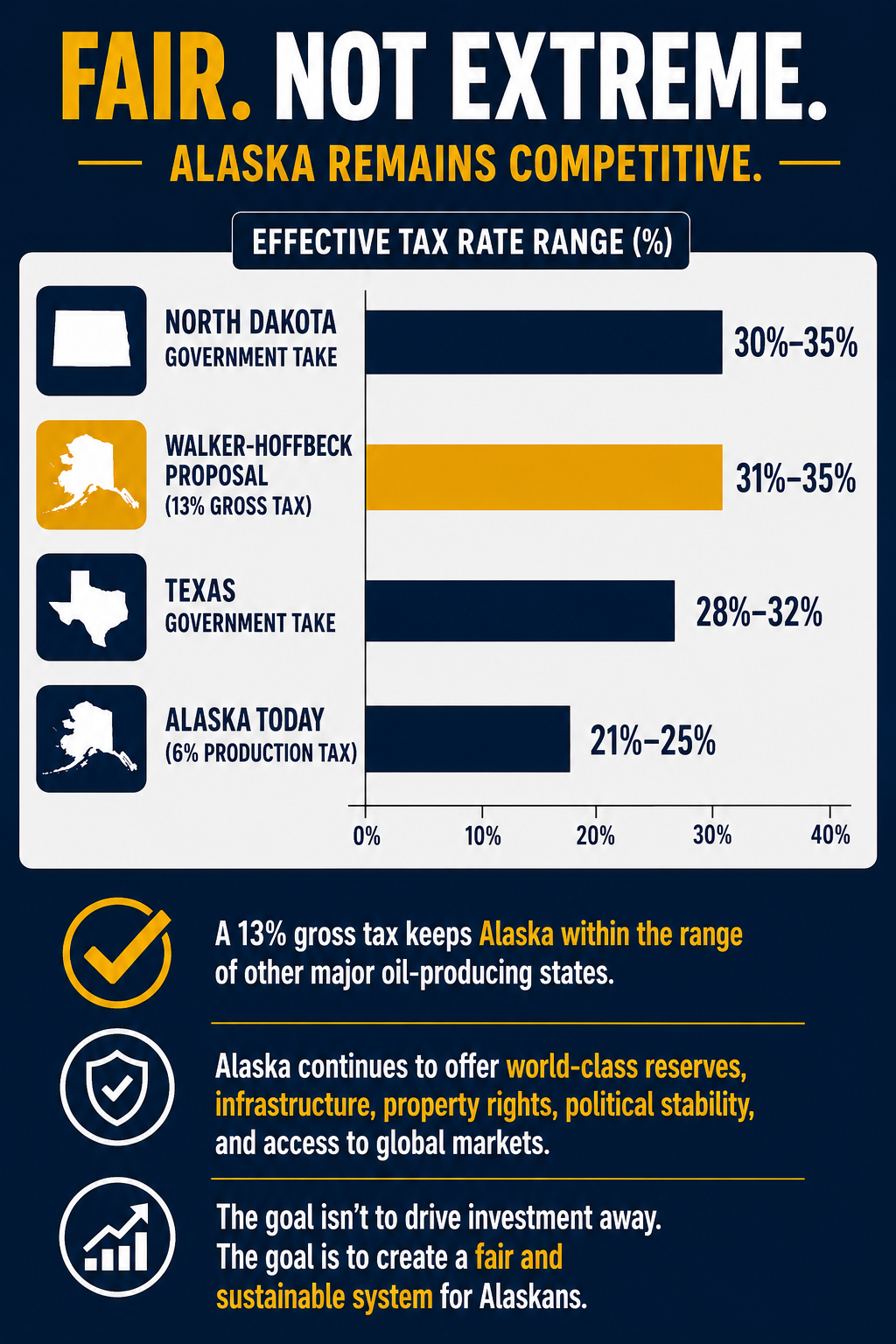
A 13% gross-value tax would keep Alaska broadly within the range of other major oil-producing states when royalties and other taxes are included.
Alaska would continue to offer:
World-class oil reserves
Existing pipeline infrastructure
Strong property rights
Political stability
Access to Pacific markets
Companies would still have good reasons to invest in Alaska. The difference is that Alaska would receive a fairer share of the value created from its resources.
THE BOTTOM LINE
This proposal is not about punishing the oil industry. It is not about government greed. It is about acknowledging a simple fact:
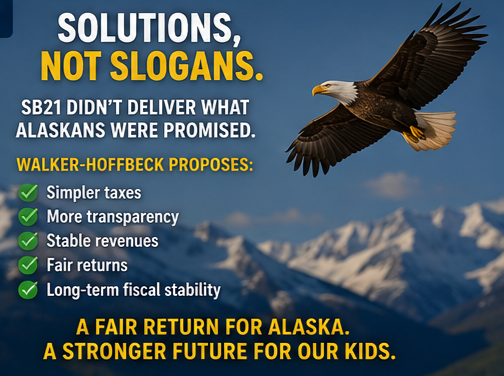
SB21 did not deliver the revenues Alaskans were promised.
Walker-Hoffbeck believes Alaska should stop relying on a complicated system that has underperformed for more than a decade and replace it with a simple, transparent 13% gross-value tax that provides a fair return to Alaska for its resources.